
The Children’s Place
How might we help The Children’s Place develop their 2022 roadmap and identify ideas to help drive their digital growth?
Skills Used


Project Ask
For this project, The Children’s Place (TCP) asked our team to help them develop their 2022 roadmap by identifying ideas that would help drive their digital growth which has seen a significant bump over the last two years. In order to do this, TCP identified five main opportunity areas where they needed our help. These areas were; how to become a uniform destination for mom, next generation home page (NGHP), loyalty & PLCC penetration, multi-brand experiences (MBE) and ratings & reviews. To get us started, TCP sent us a list of ideas they had already come up with and considered related to these five opportunity areas. It was our team’s job to go through each of these opportunity areas, complete competitive research and brainstorm new ideas to propose to them. My specific role on the team was to help with research and ideation and additionally help TCP visualize our ideas by creating mocked up screens.
Initial Approach
Revised Approach
Initial Timeline
Revised Timeline
Discovery Research
The Children’s Place CURRENT STATE EVALUATION
When we started the process of researching and brainstorming new ideas, it was important that we cross-checked the initial list of ideas given to us by TCP to make sure we weren’t proposing ideas they had already considered. Once we did this initial check we started the research process by doing a deep dive into TCP’s current state for that given opportunity area. Examples of the TCP current state evaluations for ratings & reviews and loyalty & PLCC can be seen below. As we completed this research we captured our findings in a research deck. We had individual research decks for loyalty & PLCC, NGHP and ratings & reviews.
TCP current state evaluation for ratings and reviews
TCP current state evaluation for loyalty and PLCC
Competitive Research
The next step of the research process was completing competitive research. In order to do this we looked at multiple competitive examples related to each opportunity area. At this stage it was important to look at what direct competitors such as Carter’s, Gap and Janie & Jack were doing, but also to go beyond this and see what companies out of the industry were doing. For example, when it came to researching for loyalty & PLCC we wanted to look at best in-class loyalty programs which included out-of-industry examples such as Sephora, Starbucks and Amazon. Our findings from this competitive research were captured in the same decks that are linked above.
Ratings and reviews research
Next generation home page research
Loyalty and PLCC research
Concepting and Ideation
INITIAL IDEATION
For this project, the processes of research and ideation were simultaneous. As we were completing our research we would keep track of things we saw and ideas we had to improve TCP’s current experience in a single source of truth Excel document. When adding these ideas to the Excel we would add our name, categorize the idea under its related opportunity area and assess whether we thought the idea was a crawl, walk or run idea.
SSOT Excel used to gather ideas
IDEA REFINEMENT
After each team member completed their initial research and ideation we would reconvene as a team to refine our ideas. During this stage each team member would talk through the ideas they had come up with and we would group similar ideas together in MURAL. Next we would create a very rough deck that we would use to present these ideas to our main client touchpoint, Mark. In this deck we would roughly group the ideas and present each idea with screenshots of competitive examples we had come across. Here is an example of the initial ideas deck we made for the loyalty & PLCC opportunity area.
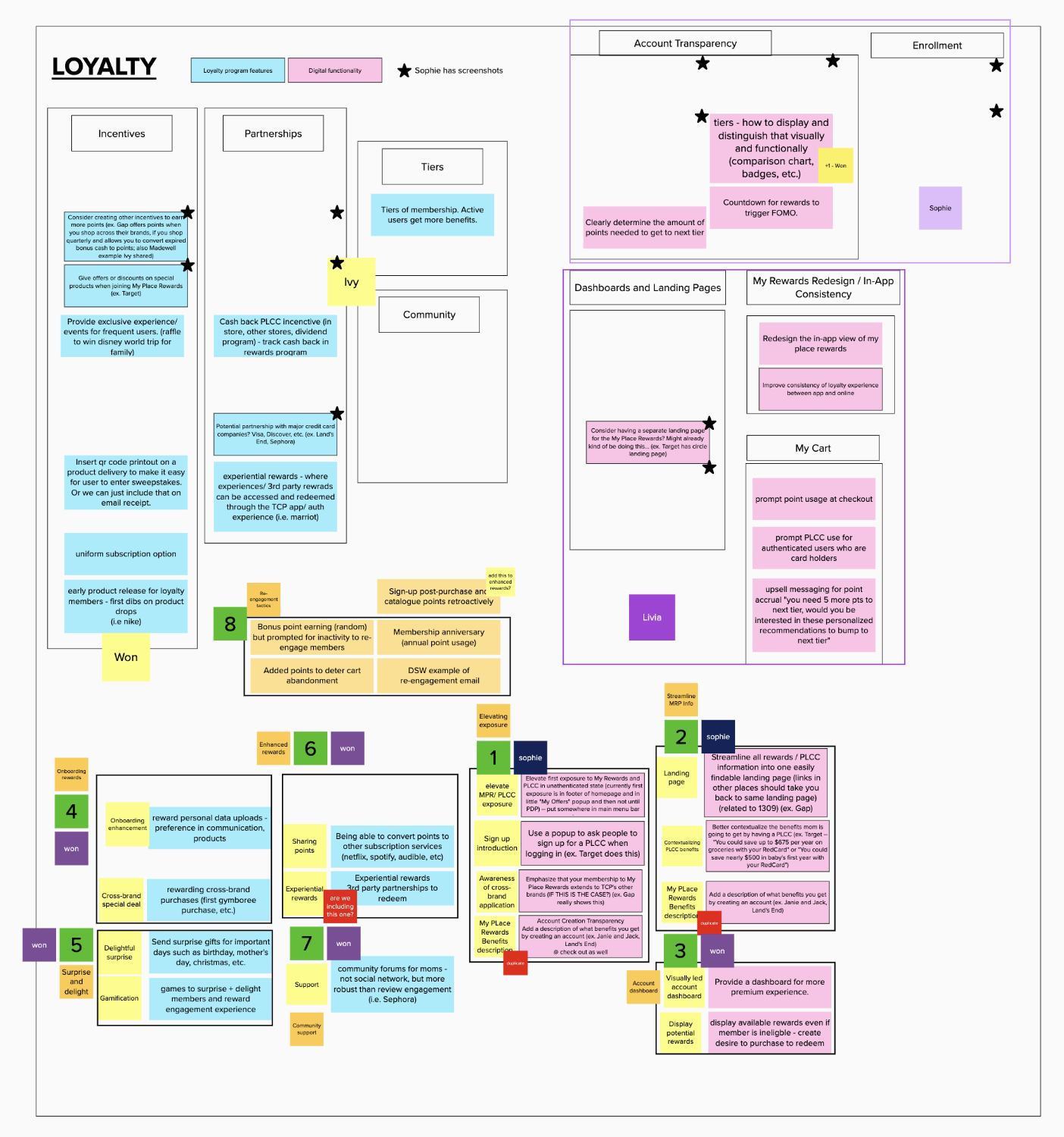
Loyalty and PLCC concept grouping
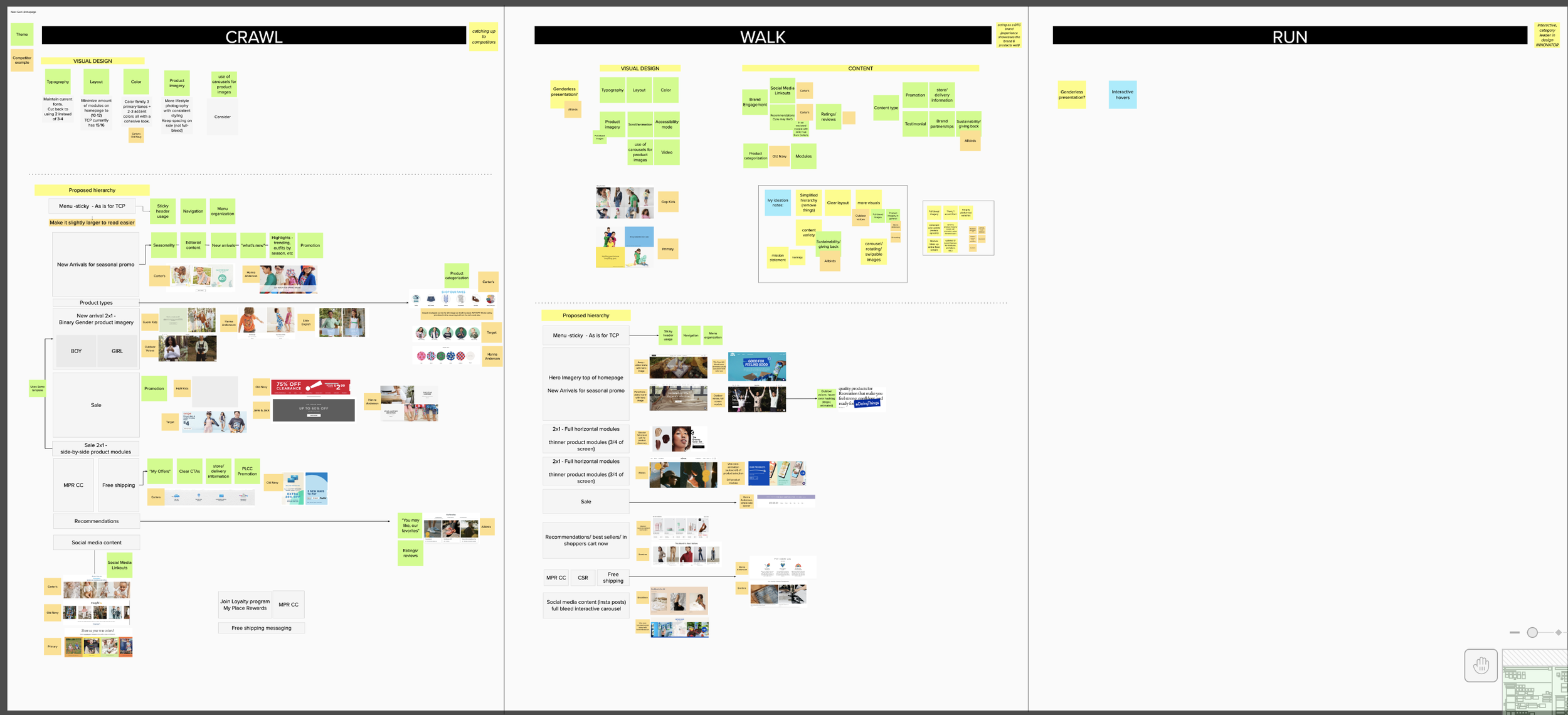
NGHP concept grouping
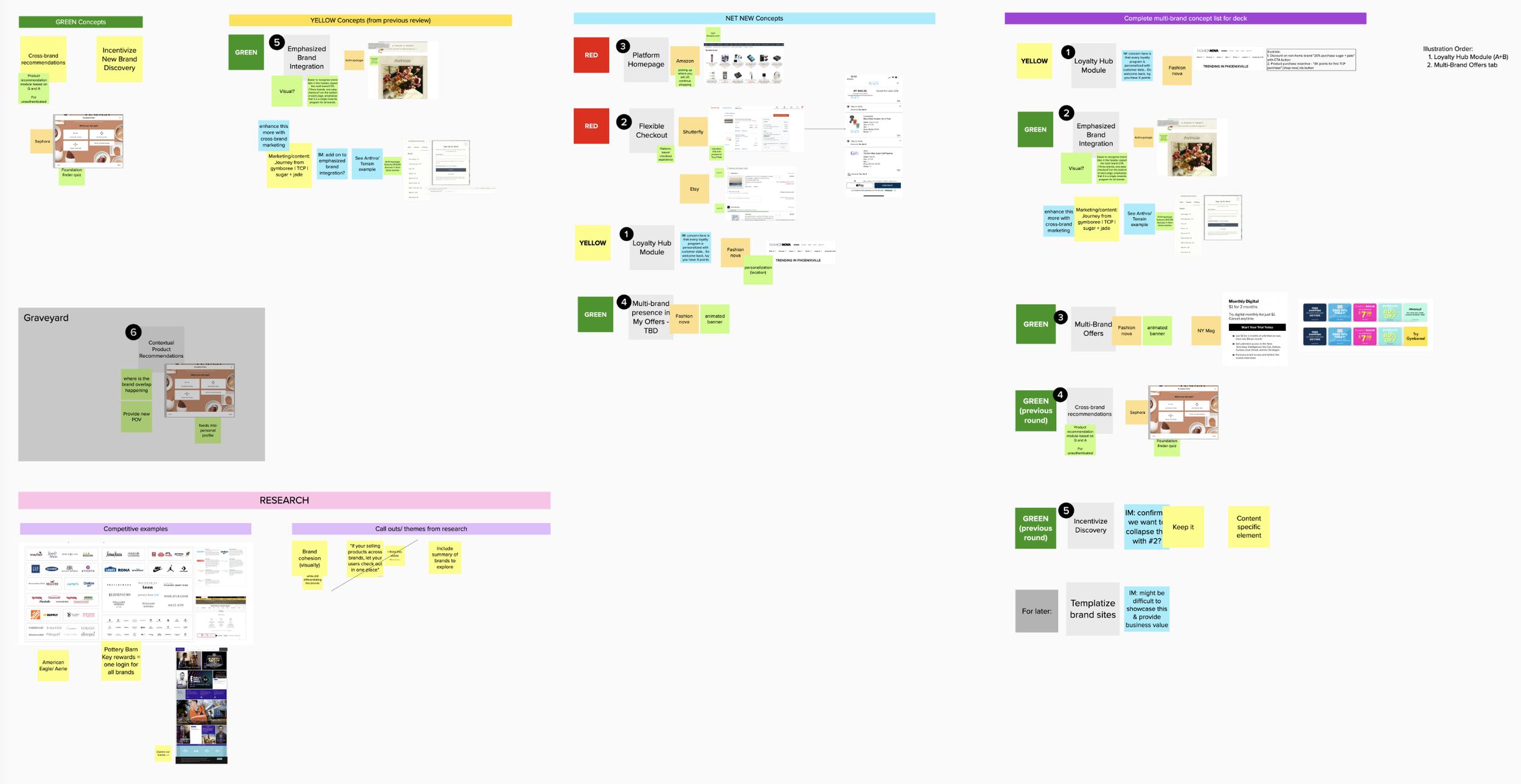
MBE concept grouping
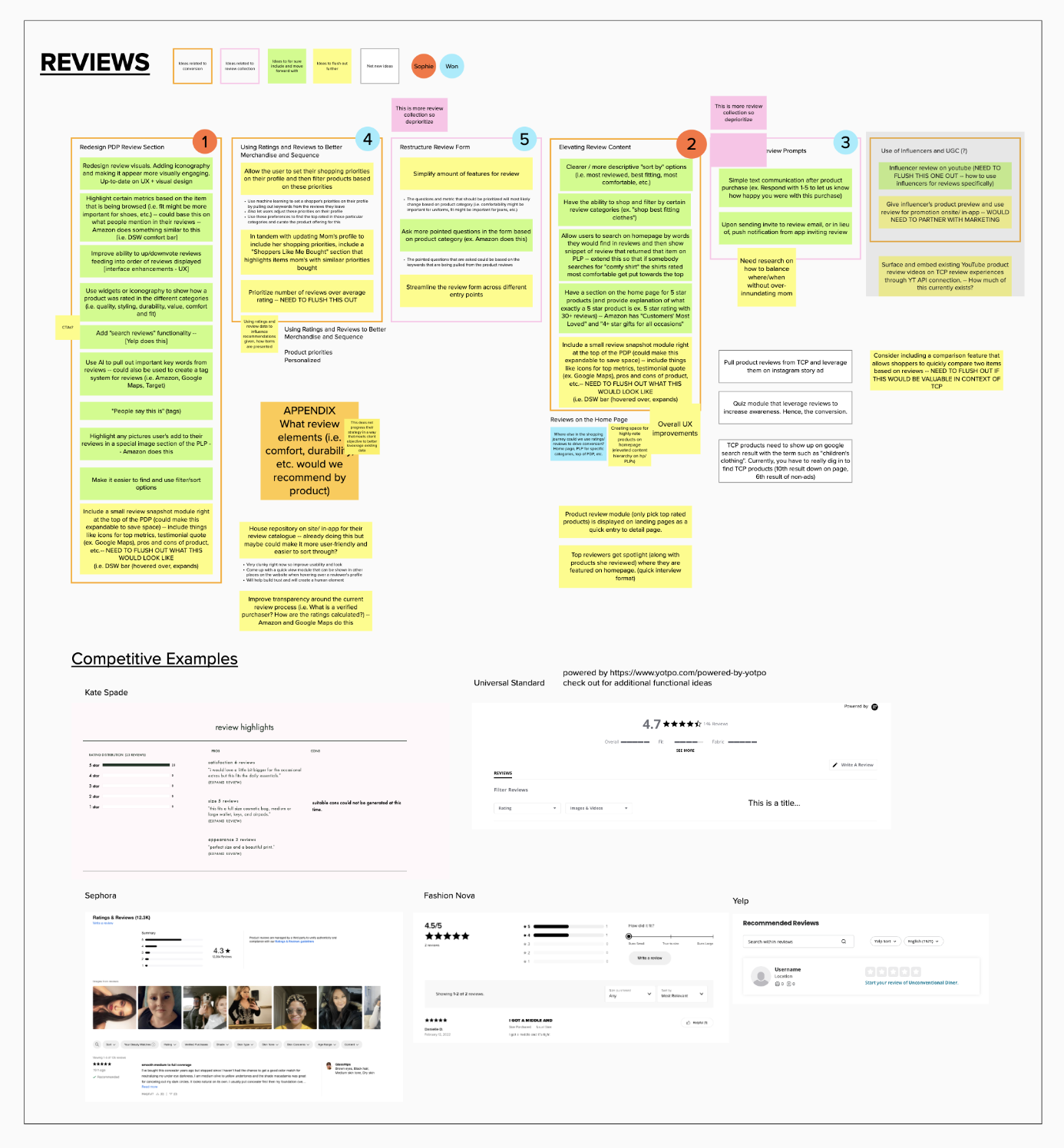
Reviews and ratings concept grouping
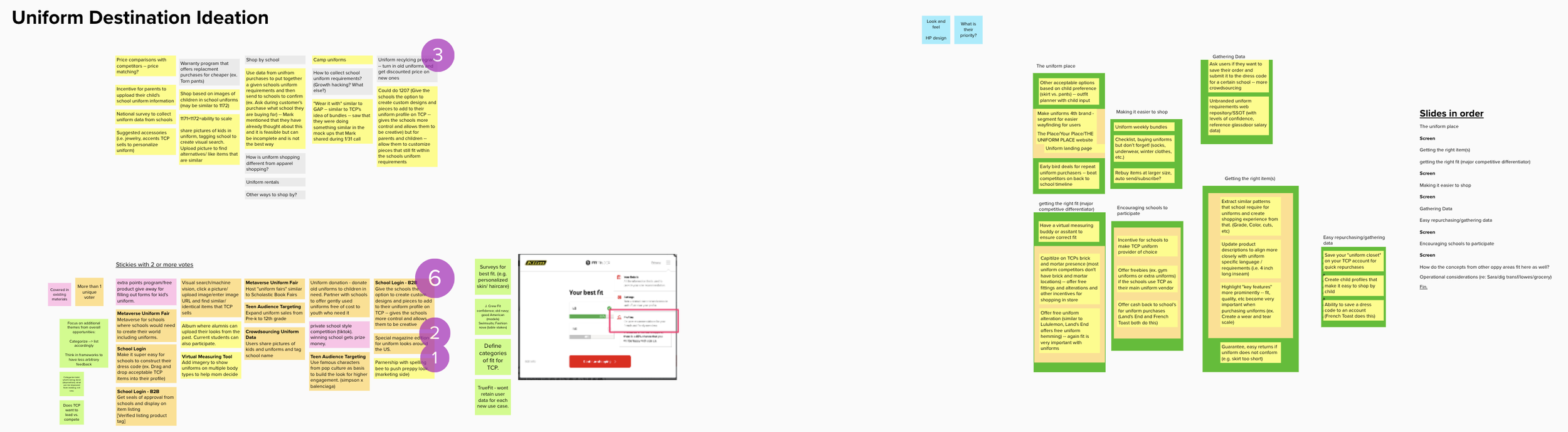
Uniform destination concept grouping
INITIAL IDEA SHARE OUTS
During our initial idea share outs with Mark we would go through the deck we created containing our ideas and designate the idea as red, yellow or green based on Mark’s feedback. Green meant that Mark liked the idea and it was good to move forward with that idea for the larger TCP presentation. Yellow meant that Mark thought the idea had legs but it needed more research and thought. Red meant that the idea was already on TCP’s road map or was not something Mark felt would resonate with the larger TCP team. These initial idea share outs with Mark were crucial because it allowed us to make sure that we were on the right track with our ideas and gave us any additional necessary context from Mark before the final share out with the larger TCP team.
Example of initial idea share for loyalty and PLCC
Example of initial idea share for loyalty and PLCC
FINAL CONCEPT PRIORITIZATION
After our initial idea share outs with Mark our team would do a concept prioritization activity where we would go through and group related green and yellow ideas and would work to think further about the yellow ideas. The result of this activity was a list of 5 to 8 final concepts that we would share in a weekly presentation with the full TCP team. Sometimes at this stage of the process additional research was necessary to flush out an idea.
Design and Visualization
Concept Visualization
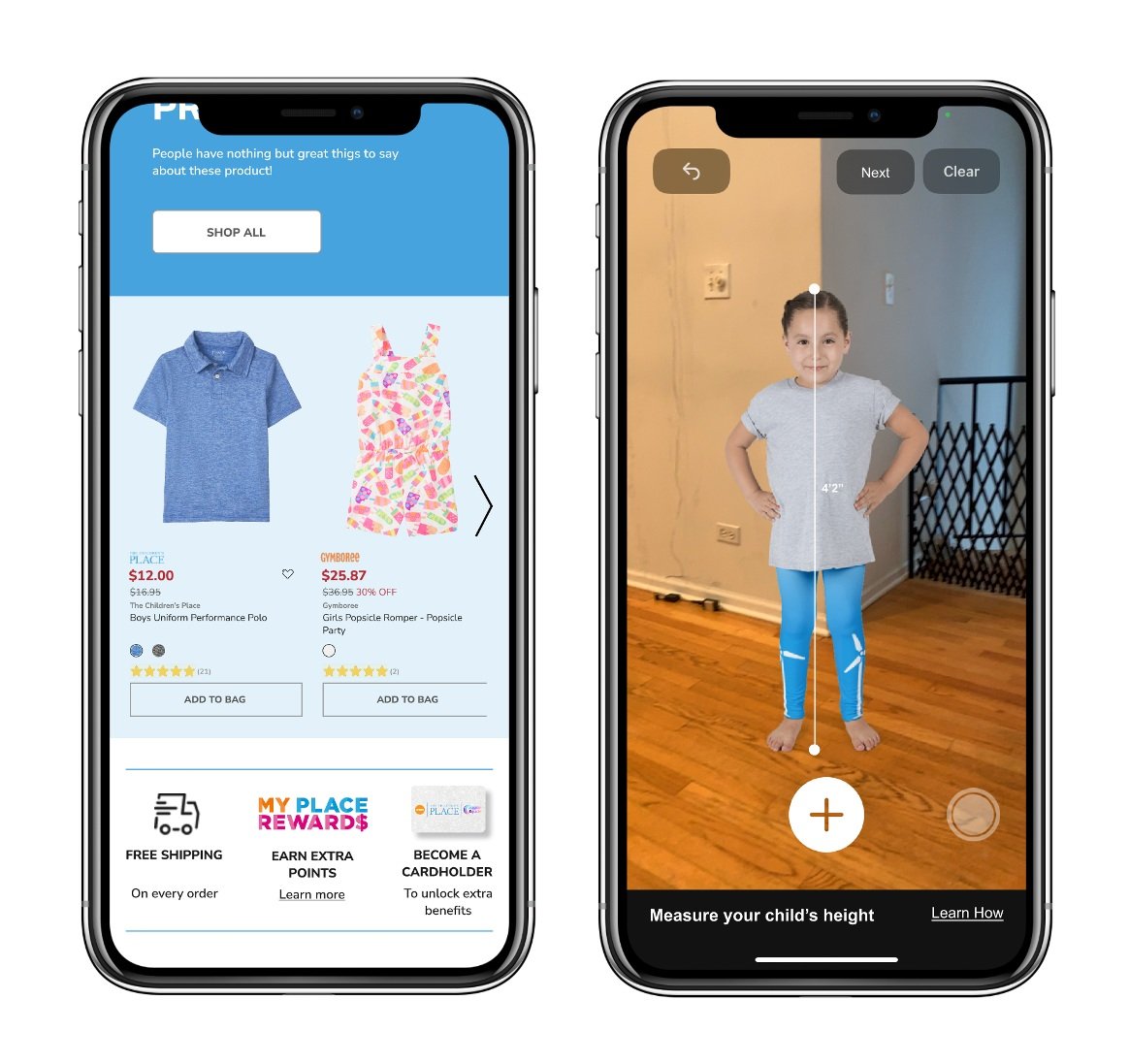
Once we had done all the research and ideation refinement and prioritization necessary to land on our final concepts, Won (the other designer) and I would split up the concepts and create visuals for each one. These visuals were an important addition to the presentation because they allowed the TCP team to see how the ideas might come to life. I used Figma to create my portion of the visuals and created them by altering current TCP mobile web pages. Some examples of the visuals I created can be seen below.
Figma file where I created all of my visuals
Uniform Destination — Purchase by Child
Next Generation Home Page — Walk
Multi-Brand Experience — Incentivize New Brand Discovery
Uniform Destination — Fit Confidence
Next Generation Home Page — Crawl
Multi-Brand Experience — Cross-Brand Recommendations
Ratings and Reviews — Redesign PDP Review Section
Loyalty and PLCC — Re-Engage Members
Ratings and Reviews — Elevating Review Content
Loyalty and PLCC — Streamline MPR Information
Final Solution
Weekly Ideation Reviews with Client
For each of the five opportunity areas, we had a weekly presentation with the full TCP team where we presented a deck containing our final 5 to 8 concepts for that opportunity area. Won and I’s first priority was creating the visuals for the decks. However, once we had finished the visuals, we would help with general deck design by finding relevant competitive examples and writing content where necessary. During these weekly pitches Livia and Ivy did most of the presenting but Won and I would jump in to add additional context about our designs and the decisions we made. The decks for the five weekly ideation reviews can be seen below.
FINAL COncept review with client
Our final deliverable for this project was a final presentation during which we shared new ideas for NGHP and MBE (since those were initially done before our new way of working) and re-shared a list of 10 prioritized ideas that TCP had chosen from the other three opportunity areas.
Potential Impact / Future Steps
After our final presentation the TCP team seemed very happy with the work that we did. Next the TCP team was going to take some of our ideas and present them to their leadership with the goal to obtain a portion of next year’s fiscal budget to implement some of the ideas. Overall, I learned a ton on this project and the TCP team was an absolute pleasure to work with.
Key Takeaways
The client will not be happy if you ask questions that have already been addressed or present ideas to them that they have already mentioned they are doing. To avoid this, it is critical to pay close attention (and preferably take notes) in client meetings.
I need to be more confident when it comes to asking questions in meetings and presenting my work.
Make use of friendly people on the client side who are willing to give you some of their time in order to make sure that real value is being created. Mark was super gracious with his time and saw our relationship as a mutually beneficial one which helped the success of this project majorly.
Although it can be awkward and uncomfortable, sometimes tough decisions regarding team structure and ways of working have to be made in order to benefit the ultimate success of the project.
Even though I am very junior, my instincts are often correct so I need to be better about not second guessing myself and speaking up when I know the answer to a question, a good path forward, etc.
It goes a long way when you let people know that they are doing a good job.
When you find something helpful it is important to say this and advocate for doing that thing again. For example, at the beginning of the project Livia, Won and I had an ideation refinement call that was really helpful so I mentioned this and then it became a part of our normal way of working moving forward.
To maintain consistency, it is important to find an effective way of working that you can follow throughout the entirety of the project. While it can be hard, the earlier you can nail this process down the better. Figuring this out upfront will help you avoid having to back track to earlier work that was done in a different way.
Using a framework like crawl, walk, run can be a really great way to ground your work and consistently present it to the client.
Recognitions
“I worked with Sophie on an innovation engagement for The Children's Place (TCP). The project was unique in that we received difficult feedback right around the time Sophie joined the project, necessitating a pivot in approach and flexibility from our PS team to meet our clients' expectations. Sophie did a fantastic job of catching up to speed mid-engagement, acclimating herself to the work she was expected to create as well as collaborating effectively with her teammates to complete our weekly deliverables. She specifically worked to help mock up strategic ideas in the TCP digital ecosystem to help our clients see our strategic vision. Sophie went above and beyond her role by helping to collaboratively ideate innovative experiences and design interactions TCP customers would appreciate in addition to designing how they could come to life. I was especially impressed with Sophie's attention to detail in the designs that she created. She always made sure that each weekly presentation was cohesive in relation to the larger project we were working on delivering, which helped our clients see the vision as it came together; generating buy-in.” - Livia Sanders
“Sophie demonstrated great work ethic and a professionalism. She was good at receiving feedback, went extra miles on ideation and produced the works that client favored. She is a good team player and a hard-working person. I would recommend her to any teams. Sophie was transparent with the work she was doing and sought guidance when help was needed. Her research driven work helped the team to look at problem with different perspective and was a great asset to help the team move in the right direction.” - Wonjun Song
“Sophie was a strong member of the TCP team and design track. She always was prepared to take notes, ask questions, share her progress updates, and offer to lend a hand with work that needed to get done. She remained upbeat in internal calls and also did a great job sharing brief design updates in client presentations. I’m so glad I got to work with her during this short project. She was great to talk to and share a second opinion about questions I had as well.” - Ivy McCleary
Contributions
I would like to say a special thank you to my project team members, Livia Sanders, Wonjun Song and Ivy McCleary, my project director, Sara Alloy and the team members I worked with from The Children’s Place.